
Overview
Hydra is built on scalable Azure PaaS services and is designed to meet the needs of small deployments as well as large, multi-tenant virtual desktop environments. Its architecture enables horizontal growth and supports both production-grade workloads and standby configurations for disaster recovery.
Scalability
Hydra uses the following Azure resources by default:
-
App Service (Standard S0)
Provides compute resources for the Hydra control plane. The S0 tier supports auto-scaling and can be increased to higher tiers (P1v2 and beyond) for greater performance, memory, and concurrency. -
Azure SQL Database (Standard S0)
Handles configuration and metadata storage. The database tier can be vertically scaled as needed to support increased load, and optionally configured with geo-replication. -
Log Analytics Workspace
Designed for horizontal scalability. As tenant and session activity grows, diagnostic data is automatically ingested and retained based on workspace policies.
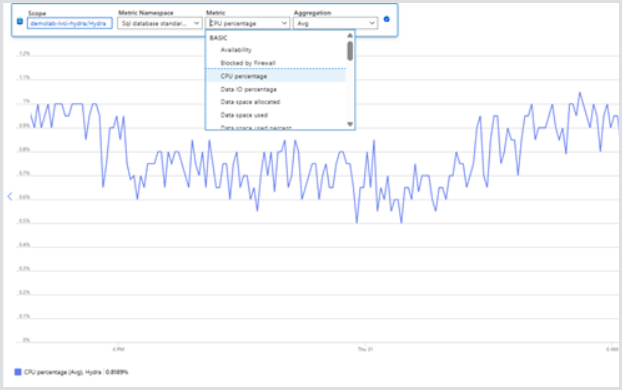
Hydra’s modular service model ensures that growth in one area (e.g., tenant count or session activity) can be handled by scaling the associated service independently. Using Azure’s built-in monitoring metrics, you can ensure both the application and SQL databases are free of resource contention:
High Availability
Hydra is backed by Azure’s App Service and SQL SLA guarantees. For additional HA and DR resilience, the recommended pattern is region-paired deployments:
-
A primary Hydra instance actively manages host provisioning and automation in the primary region.
-
A secondary Hydra instance is deployed in a different Azure region in standby mode, configured to manage the failover region’s AVD environment.
-
Each instance is logically scoped to a specific set of resources and does not share databases or configuration.
This approach minimizes regional dependency and allows rapid activation of the standby environment in the event of a regional outage.
Hydra does not yet support automatic configuration replication or seamless failover between regions. Future enhancements will introduce support for config synchronization, shared control planes, and more robust HA scenarios.