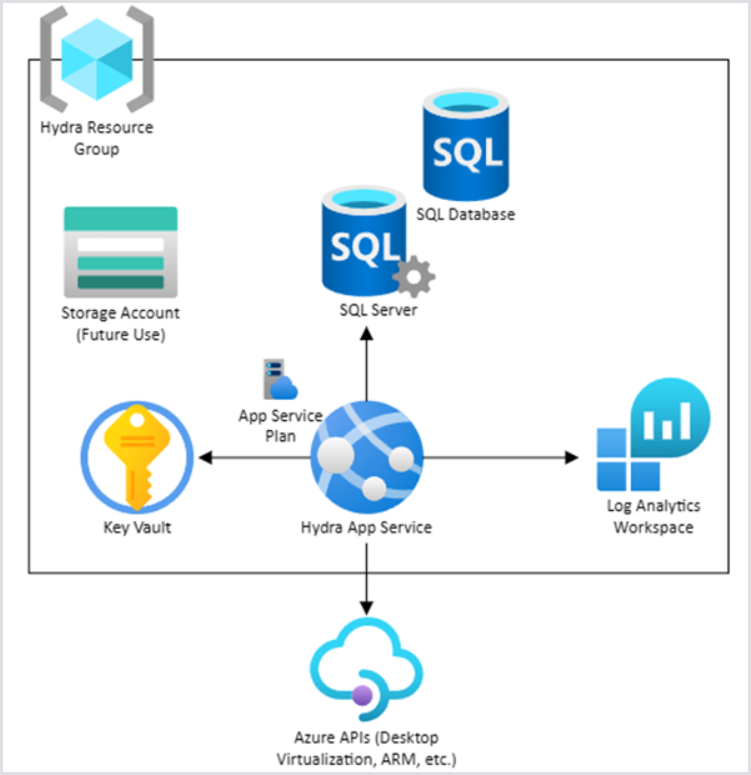
The Hydra platform is designed with a modular, cloud-native architecture that aligns with the principles of scalability, tenant isolation, and operational simplicity. Its components work together to automate session host provisioning and deliver centralization across distributed AVD environments - all while integrating securely with your existing Azure frameworks.
At a high level, Hydra operates as a control plane layered over Azure Virtual Desktop. It interacts with existing AVD host pools, Azure Resource Manager (ARM), and identity services to manage virtual desktops within defined tenant boundaries. Each tenant is mapped logically within Hydra’s configuration, allowing for delegated access and scoped resource provisioning, ideal for MSPs.
The architecture separates control and data planes, ensuring that administrative workflows and operational automation can operate independently of end-user sessions. This also allows for role-based access control (RBAC), including self-service.
The following diagram illustrates the key components and their relationships within the Hydra logical architecture: